
This document describes an LC/MS method that can simultaneously detect CYP3A4, CYP2D6 and CYP2C9 metabolites with high sensitivity
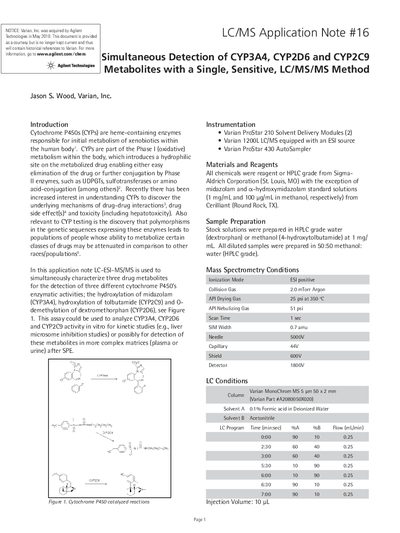
This document details an analytical method using Liquid Chromatography-Tandem Mass Spectrometry (LC-ESI-MS/MS) to characterize three specific drug metabolites: the hydroxylation of midazolam for CYP3A4, hydroxylation of tolbutamide for CYP2C9, and O-demethylation of dextromethorphan for CYP2D6. The method is designed for in vitro kinetic studies or detection in complex matrices like plasma or urine following solid-phase extraction (SPE).
The note specifies the required Varian instrumentation, including ProStar solvent delivery modules, a 1200L LC/MS system with an ESI source, and a ProStar 430 Autosampler. It provides detailed mass spectrometry conditions, such as ionization mode, collision gas pressure, and specific precursor/product ions for each analyte, along with the liquid chromatography gradient program.
| Collision Gas Pressure | 2.0 mTorr Argon |
|---|---|
| API Drying Gas Temperature | 350 °C |
| Injection Volume | 10 uL |
| Column Dimensions | 5 pm 50x 2 mm |
The method detects the hydroxylation of midazolam (CYP3A4), hydroxylation of tolbutamide (CYP2C9), and O-demethylation of dextromethorphan (CYP2D6).
The limits of quantitation are 1.0 pg for 4-hydroxytolbutamide, and 0.5 pg for both -hydroxymidazolam and dextrorphan.