
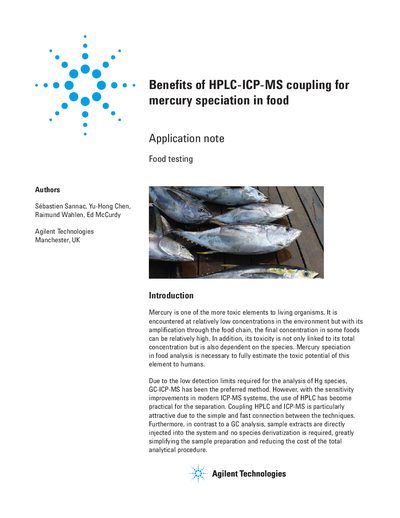
Mercury is one of the more toxic elements to living organisms. It is encountered at relatively low concentrations in the environment but with its amplification through the food chain, the final concentration in some foods can be relatively high. In addition, its toxicity is not only linked to its total concentration but is also dependent on the species. Mercury speciation in food analysis is necessary to fully estimate the toxic potential of this element to humans. Due to the low detection limits required for the analysis of Hg species, GC-ICP-MS has been the preferred method. However, with the sensitivity improvements in modern ICP-MS systems, the use of HPLC has become practical for the separation. Coupling HPLC and ICP-MS is particularly attractive due to the simple and fast connection between the techniques. Furthermore, in contrast to a GC analysis, sample extracts are directly injected into the system and no species derivatization is required, greatly simplifying the sample preparation and reducing the cost of the total analytical procedure.
The document details the benefits of coupling High Performance Liquid Chromatography (HPLC) with Inductively Coupled Plasma Mass Spectrometry (ICP-MS) for analyzing mercury species in food. It highlights that this method simplifies sample preparation by avoiding derivatization required in Gas Chromatography (GC). The study evaluates the separation of inorganic, methyl-mercury, ethyl-mercury, and phenyl-mercury compounds.
The system can operate at pressures up to 600 bar.
The analysis covers a range from approximately 100 ng/L up to 10 pg/L.
The mobile phase ramps from 2% methanol to 90% over one minute.