
This Application Note shows that unwanted retention and peak tailing of adenosine triphosphate can be completely prevented when using the Agilent 1260 Infi nity Bio-inert Quaternary LC System. Due to the iron and steel-free design of the Agilent 1260 Infi nity Bio-inert Quaternary LC System, phosphate compounds can be analyzed without any issues regarding the formation of phosphate-iron complexes found with stainless steel systems. Even in the presence of high organic mobile phases, good peak shapes were observed without peak tailing or area reduction.
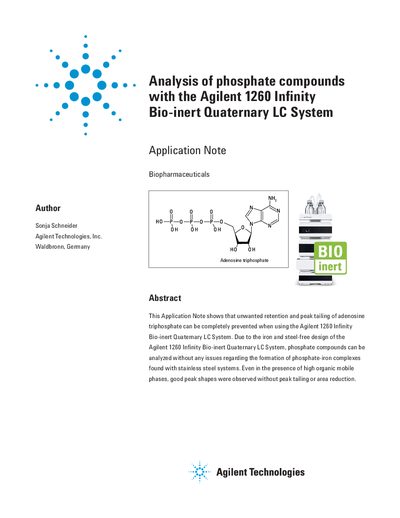
This document serves as an application note for the Agilent 1260 Infinity Bio-inert Quaternary LC System, specifically addressing the analysis of phosphate compounds such as adenosine triphosphate (ATP). It highlights how the system's iron and steel-free design prevents unwanted retention and peak tailing caused by phosphate-iron complexes found in standard stainless steel systems.
The note details an experimental comparison between a standard stainless steel-based 1260 Infinity Quaternary LC System and the Bio-inert version. Using ATP as a sample, the study shows that while the standard system suffers from significant peak tailing and area reduction with high organic mobile phases, the Bio-inert system maintains good peak shapes without retention issues.
The system prevents unwanted retention and peak tailing of adenosine triphosphate that typically occurs with stainless steel systems.
The system uses an iron and steel-free design with PEEK tubing inside stainless steel outside to create a metal-free sample flow path.
The analysis uses a flow rate of 0.5 mL/min, an injection volume of 0.2 µL, and a temperature of 40°C.