
This document is a product specification for the NE/SE566 function generator. It introduces its features and characteristics.
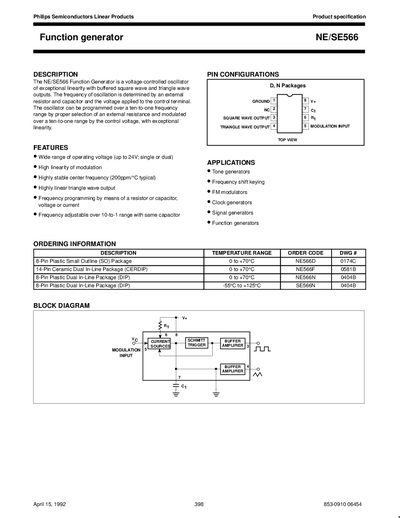
The NE/SE566 is a voltage-controlled oscillator designed for highly linear frequency modulation, providing simultaneous square wave and triangle wave outputs. The oscillation frequency is determined by an external resistor and capacitor, while the control terminal allows programming over a ten-to-one range via voltage or current.
Key features include exceptional linearity of modulation, a highly stable center frequency (200ppm/°C typical), and operation with supply voltages up to 24V. The device is available in various packages including SO, CERDIP, and DIP, with operating temperature ranges from -55°C to +125°C for the SE566 variant.
| Frequency drift with temperature | 200 ppm/°C typical |
|---|---|
| Maximum operating temperature (SE566) | -55 to +125 °C |
| Power dissipation | 300 mW |
The oscillator can be programmed over a ten-to-one frequency range by proper selection of an external resistance.
The device has a highly stable center frequency with a drift of 200ppm/°C typical.