
This document describes the features and characteristics of Philips Semiconductors BT139X series triacs, which are intended for applications requiring high bidirectional transient and blocking voltage capability, as well as high thermal cycling performance. Typical applications include motor control, industrial and domestic lighting, heating, and static switching.
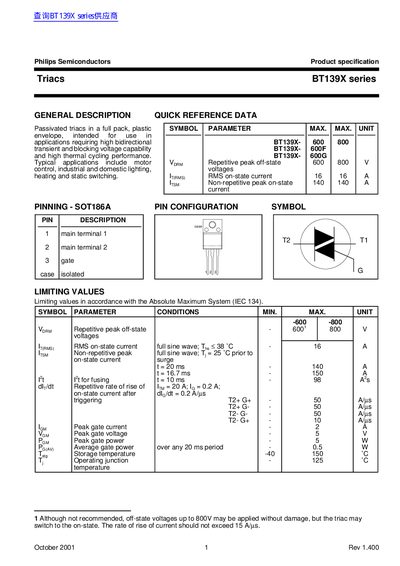
This document provides a product specification for the BT139X series of passivated triacs in a full pack plastic envelope. These devices are designed for applications requiring high bidirectional transient and blocking voltage capability, such as motor control, industrial lighting, heating, and static switching.
The datasheet details general descriptions, quick reference data, limiting values, isolation limits, thermal resistances, static characteristics (including gate trigger current and latching current), dynamic characteristics, and mechanical dimensions for the SOT186A package.
| RMS on-state current | 16 A |
|---|---|
| Thermal resistance junction to ambient (free air) | 55 K/W |
The triacs are in a full pack, plastic envelope with SOT186A pinning.
The thermal resistance is 5.5 K/W when no heatsink compound is used.