
This document describes the features and characteristics of the PDTC123ET NPN resistor-equipped transistor, including built-in bias resistors, simplified circuit design, and reduction of components and board space. It is especially suitable for space reduction in interface and driver circuits, and inverter circuit configurations without the use of external resistors.
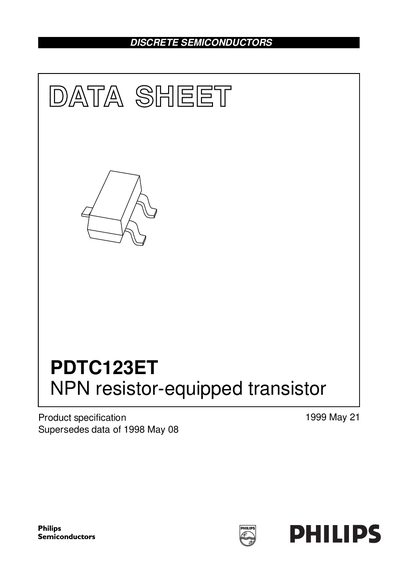
The document describes the Philips PDTC123ET, an NPN transistor featuring built-in bias resistors (R1 and R2) to simplify circuit design. It is designed for applications requiring space reduction in interface and driver circuits, such as inverter configurations without external resistors.
Technical specifications include a maximum collector-base voltage of 50 V and a peak collector current of 100 mA. The device operates within an ambient temperature range of -65 to +150 °C when mounted on an FR4 printed-circuit board.
| Collector-base voltage (open emitter) | 50 V |
|---|---|
| Peak collector current | 100 mA |
| Total power dissipation (Tamb < 25 °C) | 250 mW |
| Storage temperature range | -65 to +150 °C |
| Input resistor (typical) | 2.2 kΩ |
The device includes built-in bias resistors R1 and R2, which typically have a value of 2.2 kΩ each.
The transistor is housed in a SOT23 plastic surface mounted package with 3 leads.