
2SA1194(K) is a silicon PNP epitaxial transistor produced by Hitachi. It has high gain characteristics and can be used in high gain amplifiers.
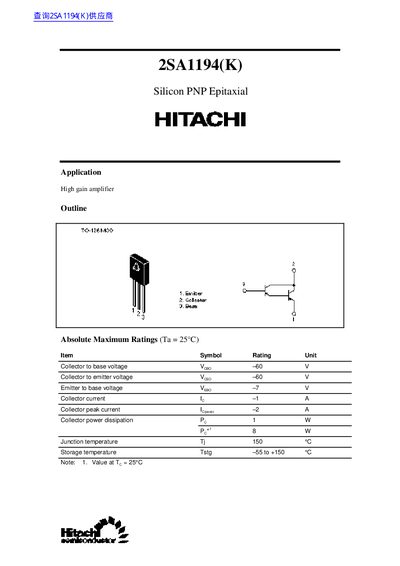
The 2SA1194(K) is a silicon PNP epitaxial transistor intended for high‑gain amplifier applications. The document lists its absolute maximum ratings, typical electrical parameters, and switching characteristics to aid designers in selecting and using the device.
Key specifications include collector‑to‑base voltage of –60 V, collector‑to‑emitter voltage of –60 V, a typical DC current gain of 1000, and turn‑on/off times of 0.7 µs and 0.8 µs respectively. Legal notices and usage restrictions, such as the prohibition of medical applications without explicit approval, are also included.
| Collector‑to‑base voltage (Vcbo) | -60 V |
|---|---|
| Collector‑to‑emitter voltage (Vceo) | -60 V |
| Emitter‑to‑base voltage (Vebo) | 7 V |
| Collector current (Ic) | -1 A |
| Collector peak current (Icp) | -2 A |
| Collector power dissipation (Pc) | 1 W |
| Junction temperature (Tj) | 150 °C |
| Storage temperature (Tstg) | -55 °C to +150 °C |
| Turn‑on time (ton) | 0.7 µs |
| Turn‑off time (toff) | 0.8 µs |
| DC current gain (hFE) | 1000 (typical) |
| Collector‑to‑emitter saturation voltage (Vcesat) | -2.0 V |
The maximum collector‑to‑base voltage is –60 V.
The typical DC current gain is 1000.
Turn‑on time is 0.7 µs and turn‑off time is 0.8 µs.
No, the device is not authorized for medical applications without written consent from Hitachi.