
This document introduces the features and characteristics of 2SC4877, including applications, absolute maximum ratings, and electrical characteristics.
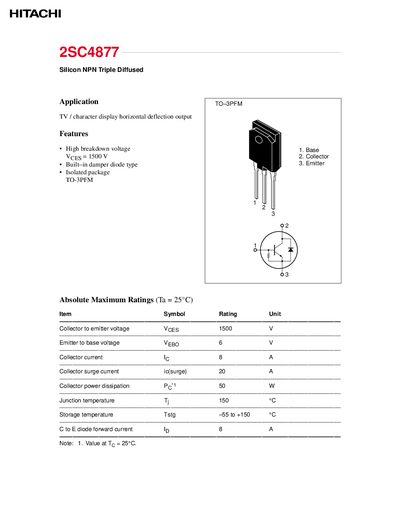
This datasheet describes the Hitachi 2SC4877 silicon NPN triple‑diffused transistor, including its key features such as high breakdown voltage and an isolated TO‑3PFM package. It lists absolute maximum ratings, electrical characteristics, and typical output curves.
The document contains tables of ratings (collector‑emitter voltage, collector current, power dissipation, etc.) and graphs showing collector‑to‑emitter saturation voltage versus collector current, as well as other performance curves useful for design engineers.
| Collector‑to‑Emitter Voltage (VCE) | 1500 V |
|---|---|
| Collector Current (Ic) | 8 A |
| Collector Surge Current | 20 A |
| Collector Power Dissipation | 50 W |
| Junction Temperature (Tj) | 150 °C |
| Storage Temperature | -55 to +150 °C |
| Emitter‑to‑Base Breakdown Voltage | 8 V |
| Collector Cutoff Current | 500 µA |
| Base‑to‑Emitter Saturation Voltage (VBE(sat)) | 1.5 V |
| C‑E Diode Forward Voltage (VCE) | 3.0 V |
| Fall Time (tf) | 0.05 µs |
The maximum collector‑emitter voltage is 1500 V.
The device can handle a continuous collector current of 8 A.
The typical saturation voltage is about 5 V.
It can be stored from –55 °C to +150 °C.