
NE527 is a product manual from Philips Semiconductors. It is a high-precision analog voltage comparator with 15ns propagation delay, complementary output gates, TTL or ECL compatible outputs, wide common-mode and differential voltage range, and 5000 typical gain.
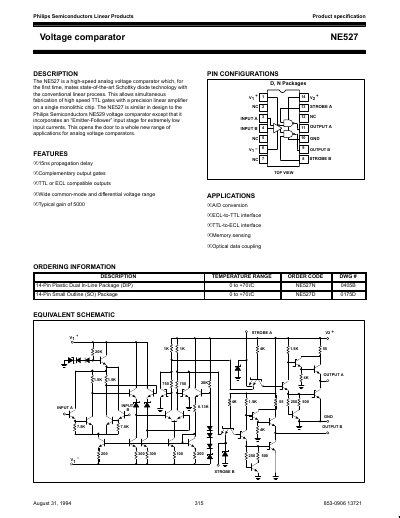
The NE527 is a high‑speed analog voltage comparator that combines Schottky diode technology with a conventional linear process, enabling fast TTL gates and a precision linear amplifier on a single chip. It features a complementary output stage, TTL or ECL compatible outputs, and a wide common‑mode voltage range.
Typical applications include A/D conversion, ECL‑to‑TTL and TTL‑to‑ECL interfacing, memory sensing, and optical data coupling. The device operates from asymmetric supply voltages and offers low input currents for sensitive analog circuits.
| Propagation delay | 15 ns |
|---|---|
| Positive supply voltage | +15 V |
| Negative supply voltage | -15 V |
| Input offset voltage (typical) | 6 mV |
| Input bias current (typical) | 2 µA |
| Operating temperature range | 0 °C to +70 °C |
The NE527 has a typical propagation delay of 15 ns.
It can operate with a positive supply up to +15 V and a negative supply down to -15 V.
The typical input bias current is 2 µA at 25 °C.
Common applications include A/D conversion, ECL‑to‑TTL and TTL‑to‑ECL interfaces, memory sensing, and optical data coupling.