
This is a PDF file about PHOENIX CONTACT PTSA 1,5/ 3-3,5-Z. The product is a 3-pin 250V connector with green color. It is assembled by soldering and the connection direction is 45 degrees.
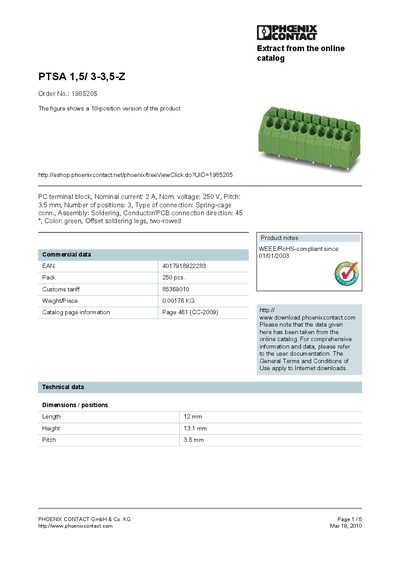
The PTSA 1,5/3-3,5-Z is a green, two‑rowed spring‑cage terminal block from Phoenix Contact. It is designed for soldering assembly with a 3.5 mm pitch and is suitable for nominal currents of 2 A and voltages up to 250 V.
The sheet provides detailed dimensions, electrical ratings, certification information (CCA, CUL, UL, VDE‑PZI) and drawing references for both 3‑position and 5‑position versions. For full product documentation, refer to the online catalog or Phoenix Contact’s website.
| Nominal current | 2 A |
|---|---|
| Nominal voltage | 250 V |
| Pitch | 3.5 mm |
| Number of positions (standard) | 3 |
| Weight per piece | 0.00176 kg |
| Certifications | CCA, CUL, UL, VDE‑PZI |
The terminal block is rated for a nominal current of 2 A.
The pitch of the terminal block is 3.5 mm.
The standard version has 3 positions.
It is certified according to CCA, CUL, UL and VDE‑PZI standards.