
The document provides specifications and dimensions for the CCM02 MK II connector, as well as its features and characteristics. The connector has 8 contacts, a mechanical life of 500,000 cycles, and is suitable for high temperature environments. It is vibration resistant, dust sealed, and has a current rating ranging from 10µA to 1A.
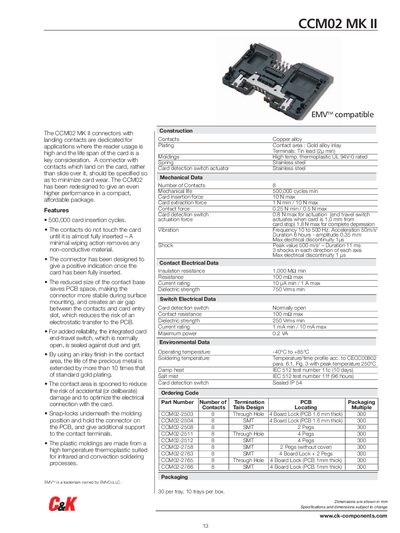
The CCM02 MK II connector is designed for high‑usage card reader applications, offering up to 500,000 insertion cycles and a contact design that minimizes card wear. Features include a sealed end‑travel switch, gold‑alloy inlay contacts, and a compact, thermoplastic housing.
The document provides detailed mechanical data, electrical performance figures, environmental limits, and ordering codes for both through‑hole and SMT versions, along with dimensional drawings and PCB layout guidance.
| Card insertion cycles | 500,000 cycles |
|---|---|
| Number of contacts | 8 |
| Mechanical life | 500,000 cycles min |
| Card insertion force | 10 N max |
| Contact resistance | 100 mΩ max |
| Insulation resistance | 1,000 MΩ min |
| Dielectric strength (contact) | 750 V min |
| Operating temperature | -40°C to +85°C |
The connector is rated for a mechanical life of at least 500,000 insertion cycles.
The contact resistance is specified as up to 100 mΩ.
It can operate from –40 °C up to +85 °C.