
Li2YCY PiMF is a low capacitance twisted pair data cable, suitable for transmission of sensitive signals and high bit rates, with enhanced requirements in respect of near-end cross-talk attenuation, and in conditions of high electrical interference on the line circuits. Therefore for measurements value transmission, field bus systems, and serial 2 wire interfaces. Cables of this type are intended for limited flexible use and for static laying in dry and damp interiors.
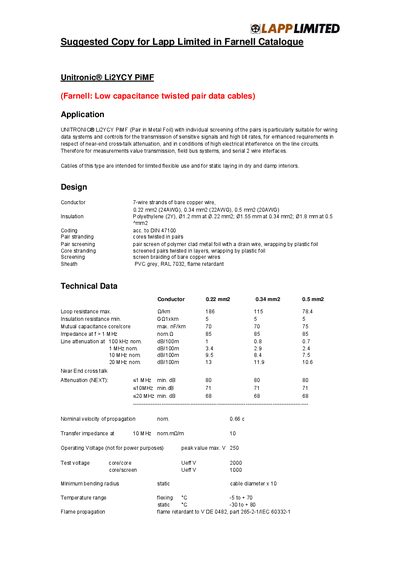
The Unitronic® Li2YCY PiMF (Pair in Metal Foil) cable features individually screened twisted‑pair conductors, making it ideal for wiring data systems, controls, measurements, field‑bus and serial 2‑wire interfaces where high bit‑rates and low cross‑talk are required. It is designed for limited flexible use and static laying in dry or damp interiors.
Technical data include conductor sizes of 0.22 mm², 0.34 mm² and 0.5 mm², loop resistance up to 186 Ω/km, insulation resistance ≥5 GΩ·km, mutual capacitance ≤75 nF/m, impedance 85 Ω, and attenuation values suitable for frequencies up to 20 MHz. The cable complies with flame‑retardant standards (V DE 0482, IEC 60332‑1) and operates up to 250 V peak.
| Conductor sizes | 0.22 mm², 0.34 mm², 0.5 mm² |
|---|---|
| Loop resistance (max) | 186 Ω/km (0.22 mm²), 115 Ω/km (0.34 mm²), 78.4 Ω/km (0.5 mm²) |
| Insulation resistance (min) | 5 GΩ·km |
| Mutual capacitance (core/core, max) | 70 nF/m (0.22 mm², 0.34 mm²), 75 nF/m (0.5 mm²) |
| Impedance (f > 1 MHz) | 85 Ω |
| Line attenuation at 100 kHz | 1 dB/100 m (0.22 mm²), 0.8 dB/100 m (0.34 mm²), 0.7 dB/100 m (0.5 mm²) |
| NEXT attenuation (1 MHz min) | 80 dB |
| Velocity of propagation | 0.66 c |
| Operating voltage (peak, not for power) | 250 V |
| Temperature range (flexing) | -5 °C to +70 °C |
| Temperature range (static) | -30 °C to +80 °C |
| Flame retardant compliance | V DE 0482, IEC 60332‑1 |
The cable can handle a peak operating voltage of up to 250 V (not for power purposes).
Flexing: –5 °C to +70 °C; Static: –30 °C to +80 °C.
Yes, it complies with flame‑retardant standards V DE 0482 and IEC 60332‑1.