
PI7C8152A is a PCI-to-PCI bridge produced by Pericom. It meets the PCI Local Bus Specification, PCI-to-PCI Bridge Specification and PCI Bus Power Management Interface Specification, supports 3.3V and 5V signaling environments, concurrent primary and secondary bus operations and 66MHz support.
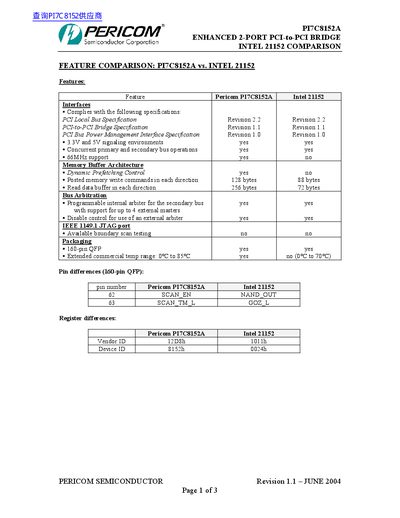
The PI7C8152A is an enhanced 2‑port PCI‑to‑PCI bridge that complies with the PCI Local Bus Specification, PCI‑to‑PCI Bridge Specification, and PCI Bus Power Management Interface Specification. It supports 3.3 V and 5 V signaling, 66 MHz operation, dynamic prefetching control, and offers a 160‑pin QFP package with an extended temperature range of 0 °C to 85 °C.
Performance testing on various motherboards shows the PI7C8152A consistently delivering higher Ethernet transfer rates than the Intel 21152, with measured speeds up to 95 Mb/s in several test cases.
| PCI Local Bus Specification compliance | yes |
|---|---|
| PCI‑to‑PCI Bridge Specification compliance | yes |
| 3.3V and 5V signaling environments | yes |
| 66 MHz support | yes |
| Dynamic Prefetching Control | yes |
| Posted memory write buffer size | 128 bytes |
| Read data buffer size | 256 bytes |
| Programmable internal arbiter for secondary bus | yes |
| Package type | 160‑pin QFP |
| Extended commercial temperature range | 0 °C to 85 °C |
It complies with the PCI Local Bus Specification, PCI‑to‑PCI Bridge Specification, and PCI Bus Power Management Interface Specification.
The device is supplied in a 160‑pin QFP package.