
The document describes an operational amplifier with ultra-low bias current, featuring low offset, low drift, high open-loop gain, and low noise. It is suitable for applications such as photodetector preamps, chromatography, electrometer amplifiers, mass spectrometers, pH probe amplifiers, and ion gage measurement.
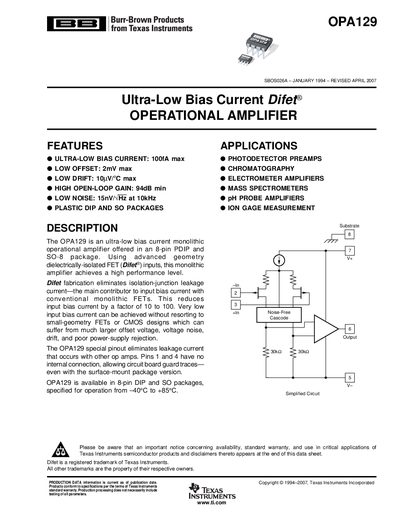
The OPA129 operational amplifier from Texas Instruments features an ultra‑low input bias current (as low as 30 fA typical, 100 fA max) and low offset voltage, making it suitable for photodetector preamps, pH probe amplifiers, and electrometer applications. It is supplied in 8‑pin PDIP and SO‑8 surface‑mount packages and operates from –40 °C to +125 °C.
The datasheet provides detailed electrical specifications, absolute maximum ratings, recommended circuit board layout with guard rings, and typical performance curves. It also includes package option addendum, mechanical dimensions, and important warranty and usage notices.
| Supply Voltage Range | 5 V to 18 V |
|---|---|
| Quiescent Current | 1.2 mA to 1.8 mA |
| Operating Temperature Range | ‑40 °C to +125 °C |
The OPA129 is available in 8‑pin PDIP and SO‑8 surface‑mount packages.
The device operates from 5 V to 18 V.