
This document describes the features and characteristics of a product, including temperature control, voltage requirements, wave soldering, etc.
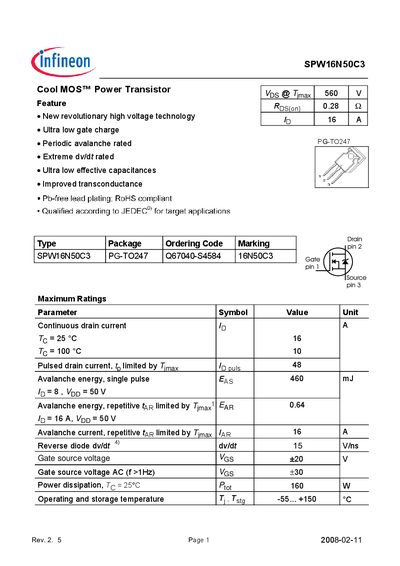
The SPW16N50C3 is a Cool MOS™ power transistor from Infineon, offering a 560 V drain‑source voltage, 16 A continuous drain current and ultra‑low gate charge. It is RoHS‑compliant, Pb‑free and designed for high‑dv/dt and avalanche‑rated applications.
The document lists maximum ratings, thermal characteristics, detailed electrical parameters, typical output and transfer curves, as well as mechanical dimensions for the PG‑TO‑247 package. These data help designers evaluate the device for power conversion, motor drives and other high‑voltage applications.
| Drain‑Source Voltage (VDS) | 560 V |
|---|---|
| Continuous Drain Current (ID) @ 25°C | 16 A |
| Power Dissipation (PD) | 160 W |
| Operating Temperature Range | -55 °C to +150 °C |
| Gate Threshold Voltage (VGS(th)) | 2.1 V – 3.9 V |
| Typical Gate Charge (Qg) | 66 nC |
The device is rated for a maximum drain‑source voltage of 560 V.
It can conduct up to 16 A continuously at a case temperature of 25 °C.
The transistor can operate from –55 °C up to +150 °C.