
This document is a datasheet for the TDA5250 D2 ASK/FSK 868MHz wireless transceiver. It describes the features and characteristics of the product.
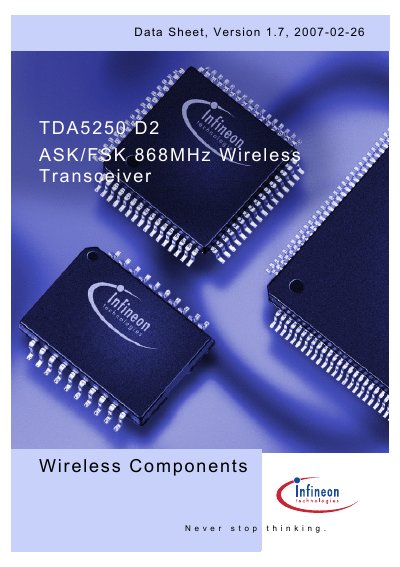
The TDA5250 D2 is a low‑power, single‑chip ASK/FSK transceiver designed for half‑duplex, low‑data‑rate communication in the 868‑870 MHz band. It integrates a power amplifier, low‑noise amplifier with AGC, double‑balanced mixer, VCO/PLL synthesizer, data filter, slicer, peak detectors and a 2/3‑wire bus interface, requiring only a few external components.
Key features include a supply voltage range of 2.1‑5.5 V, typical receive current of 9 mA and transmit current of 12 mA, transmit power up to +13 dBm, data rates up to 64 kbit/s, and sensitivity down to –109 dBm. The device is suited for alarm systems, telemetry, keyless entry, electronic metering, remote control and home‑automation applications.
| Supply voltage range | 2.1 V – 5.5 V |
|---|---|
| Typical receive current | 9 mA |
| Typical transmit current | 12 mA |
| Maximum transmit power | +13 dBm |
| Maximum data rate | 64 kbit/s |
It operates from 2.1 V to 5.5 V.
The typical receive current is 9 mA.
The transceiver can transmit up to +13 dBm.
It operates in the 868‑870 MHz ISM band.