
This document introduces the CM400DU-12NFH IGBT module from MITSUBISHI, which is suitable for high-frequency switching applications (30kHz to 60kHz). The module has high power switching capability and can be used in gradient amplifiers, induction heating, power supplies, and other fields.
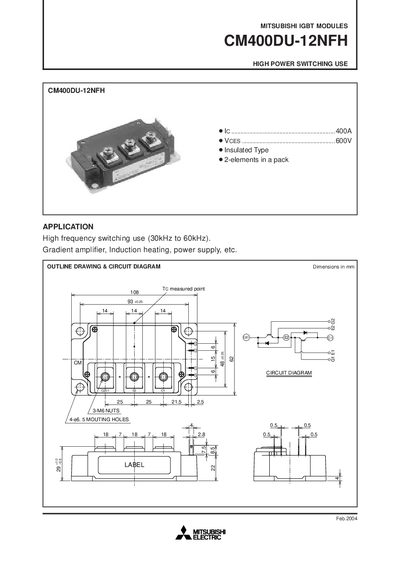
The CM400DU-12NFH is a high‑power insulated IGBT module designed for high‑frequency switching applications such as gradient amplifiers, induction heating and power supplies. It features a 2‑element pack and provides robust electrical performance up to 600 V collector‑emitter voltage.
The document lists maximum ratings, electrical characteristics, thermal data, and typical performance curves, including collector current limits, dissipation values, and switching times. It also includes outline drawings, circuit diagrams, and reverse‑recovery characteristics for the integrated free‑wheel diode.
| Continuous collector current (Ic) | 400 A |
|---|---|
| Maximum collector dissipation (Pc) | 960 W (typical) |
| Maximum collector dissipation at Tc'=25°C (Pc') | 1640 W (typical) |
| Junction temperature range (Tj) | -40 °C to +150 °C |
| Isolation voltage (Viso) | 2500 V |
| Typical weight | 400 g |
The module can handle a continuous collector current of 400 A.
The isolation voltage is rated at 2500 V (AC, 1 min).
Typical thermal resistance (Rth_j‑c) is about 0.13 °C/W.