
The Panasonic WV-CP280 series color camera has the latest DSP chip in 2007, which greatly improves the image quality. The leading automatic dark area compensation technology can use DSP (image processing technology) to restore the image in the dark area to a natural color and high contrast image without affecting the bright area. In the color mode, the horizontal resolution can reach 540 lines. Using F0.95 lens, the minimum illumination can reach 0.25Lux. These are all due to the latest DSP (digital signal processing technology) in 2007. Its appearance effectively improves the signal-to-noise ratio in low illumination. At the same time, its unique day and night conversion function can support lower illumination monitoring. In addition, this series of cameras also has various image adjustment functions, such as: powerful backlight compensation function (BLC), electronic light control function (ELC) and automatic light control function (ALC), so that it can be installed and used in various environments.
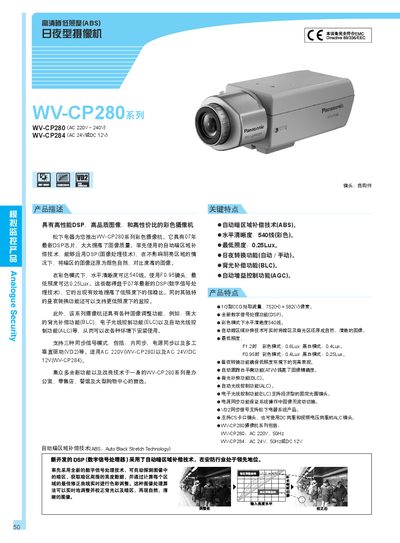
This manual describes the key features of the Panasonic WV-CP280 series camcorder, including its high‑performance DSP, automatic black‑stretch (ABS) technology, and low‑light capabilities. It also lists the supported synchronization modes and lens options.
Technical specifications such as sensor resolution, minimum illumination, power consumption, dimensions and connector details are provided, along with part names and installation notes for proper setup in various environments. This manual is written in Chinese.
| Image sensor | 752(H) x 582(V) pixels, interline transfer CCD |
|---|---|
| Horizontal resolution | 540 lines |
| Minimum illumination (color mode) | 0.4 Lux at F0.95 |
| Power consumption | 3.4 W (AC 220 V, 50 Hz) |
| Dimensions (without lens) | 67 mm (W) × 65 mm (H) × 139.5 mm (D) |
The camcorder needs a minimum illumination of 0.4 Lux at an aperture of F0.95 in color mode.
It supports three synchronization modes: internal sync, power sync, and multi‑field sync (VD2).
The image sensor provides a resolution of 752 × 582 pixels using an interline transfer CCD.