
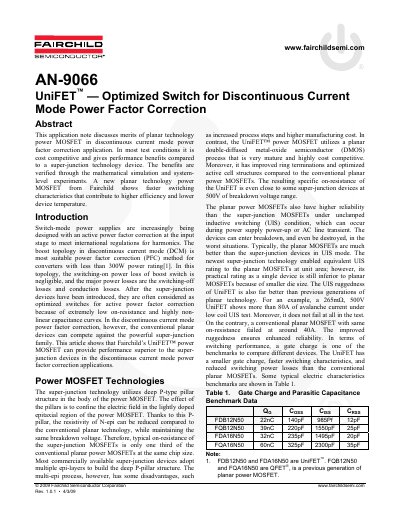
This application note discusses the advantages of planar technology power MOSFET in discontinuous current mode power factor correction application. In most test conditions, it is cost competitive and provides performance benefits compared to a super-junction technology device. The benefits are verified through mathematical simulation and system-level experiments. A new planar technology power MOSFET from Fairchild shows faster switching characteristics that contribute to higher efficiency and lower device temperature.
This document discusses the merits of Fairchild's UniFET™ planar technology power MOSFETs in discontinuous current mode (DCM) power factor correction (PFC) applications. It argues that UniFETs offer performance benefits and cost competitiveness compared to super-junction technology devices, particularly in converters with less than 300W power rating.
This topology is most suitable for converters with a power rating of less than 300W.
A 265m, 500V UniFET shows more than 80A of avalanche current under low coil UIS test.
The simulation was set to a single cycle of AC input.