
This application note presents a LED application design guide using the FL7930 BCM Power-Factor-Correction (PFC) controller. It includes the design steps for inductor and Zero-Current-Detection (ZCD) circuit, component selection, and control loop closure. The FL7930 has additional features such as overvoltage protection and PFC-ready pin for triggering other power stages or synchronization with PFC voltage condition.
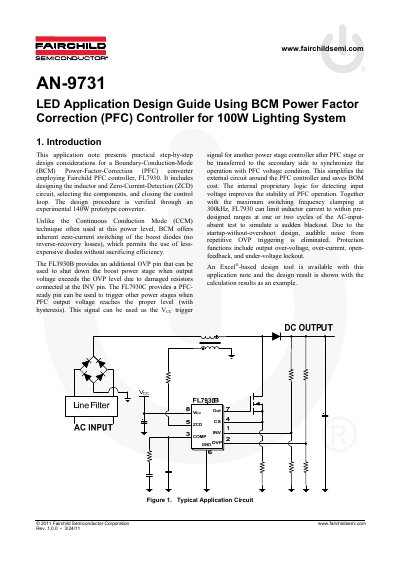
This document is an application note detailing the practical step-by-step design considerations for a Boundary-Conduction-Mode (BCM) Power Factor Correction (PFC) converter. It specifically employs the Fairchild PFC controller, FL7930. The guide covers designing the inductor and Zero-Current-Detection (ZCD) circuit, selecting components, and closing the control loop. The design procedure is verified through an experimental 140W prototype converter.
| Maximum Switching Frequency | 300kHz |
|---|---|
| Output Power (Prototype) | 140W |
| Line Voltage Range | 90~265V AC |
| Nominal Output Voltage | 400V |
| Output Load Current | 0.35A |
| Hold-up Time Requirement | One Line Cycle |
| Output Voltage Ripple | Less than 8VPP |
| Minimum Switching Frequency | Higher than 50kHz |
| Control Bandwidth | 5~15Hz |
BCM offers inherent zero-current switching of the boost diodes, which eliminates reverse-recovery losses and allows the use of less expensive diodes.
Yes, it includes a startup-without-overshoot feature where an internal proportional gain controller prevents overshoot at startup before an external compensator takes over.
The controller checks if the input AC voltage exists; if the input voltage does not exist, soft-start is reset and waits until AC input voltage is applied again.