
This application note presents a LED application design guide using BCM Power Factor Correction (PFC) controller for a 200W lighting system. The design procedure is verified through an experimental 200W prototype converter.
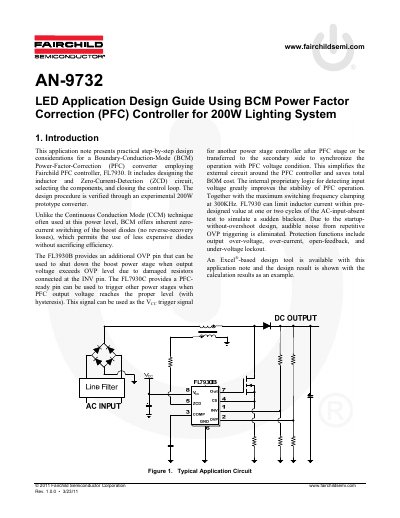
This document presents a practical step-by-step design guide for a Boundary-Conduction-Mode (BCM) Power-Factor-Correction (PFC) converter utilizing the Fairchild FL7930 controller. It highlights the benefits of BCM over Continuous Conduction Mode (CCM), such as inherent zero-current switching which allows for the use of less expensive diodes without sacrificing efficiency. The guide explains the operation principles, including variable switching frequency behavior and the elimination of diode reverse recovery losses.
| Maximum Switching Frequency | 300KHz |
|---|---|
| Output Power | 200W |
| Line Voltage Range | 90~265V AC |
| Nominal Output Voltage | 400V |
| Output Current | 0.5A |
| Output Voltage Ripple | Less than 8V PP |
| Minimum Switching Frequency | Higher than 50kHz |
| Control Bandwidth | 5~15Hz |
BCM offers inherent zero-current switching of the boost diodes, which eliminates reverse-recovery losses and permits the use of less expensive diodes without sacrificing efficiency.
During startup, the feedback loop is controlled by an internal proportional gain controller to prevent overshoot, and an external compensator takes over after an internally fixed transition time.
The FL7930 detects the absence of input voltage, resets the soft-start, and waits until the AC input voltage is applied again to prevent stress on the MOSFET and diode.