
This application note describes a test method for testing the safe operating area of power MOS transistors without a heat sink. The method does not use a heat sink, but relies on the thermal capacitance (CT) of the package to allow prediction of the case temperature during SOA testing.
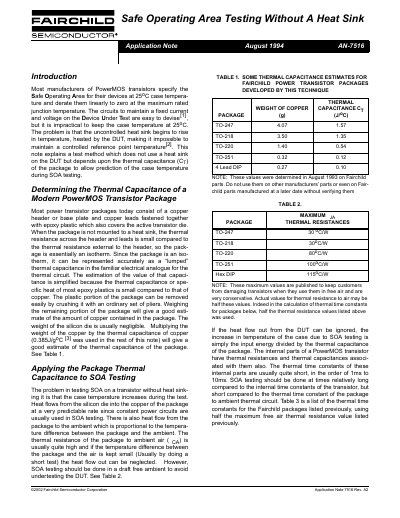
Most manufacturers specify the Safe Operating Area (SOA) at 25°C case temperature, but maintaining this temperature during testing is impractical because the uncontrolled heat sink rises in temperature. This document explains a test method that does not use a heat sink on the Device Under Test (DUT). Instead, it relies on the thermal capacitance of the package to predict the case temperature during SOA testing.
The note details how to determine the thermal capacitance of modern PowerMOS transistor packages by weighing the copper content after removing the epoxy plastic. It provides tables with estimated thermal capacitances and thermal resistances for various Fairchild packages (TO-247, TO-218, TO-220, etc.). The document includes examples calculating SOA capability for specific transistors like RFP70N06 and RFD3055 using successive approximation to verify the technique.
| Thermal Capacitance (TO-247) | 1.57 J/°C |
|---|---|
| Thermal Capacitance (TO-218) | 1.35 J/°C |
| Thermal Capacitance (TO-220) | 0.54 J/°C |
| Thermal Capacitance (TO-251) | 0.12 J/°C |
| Thermal Resistance to Air (TO-247) | 30 °C/W |
| Thermal Time Constant (TO-247 Free Air) | 23.6 s |
The test method depends upon the thermal capacitance of the package to allow prediction of the case temperature during SOA testing.
The plastic portion can be removed by crushing it with pliers, and weighing the remaining copper allows for an estimate based on its specific heat.
The suitable time range over which satisfactory measurements can be made is 100ms to 580ms.