
Fairchild Semiconductor AN-7517 Practical Aspects of Using PowerMOS Transistors to Drive Inductive Loads

This document introduces practical aspects of using PowerMOS transistors to drive inductive loads, including application scenarios, circuit principles, and characteristic analysis.
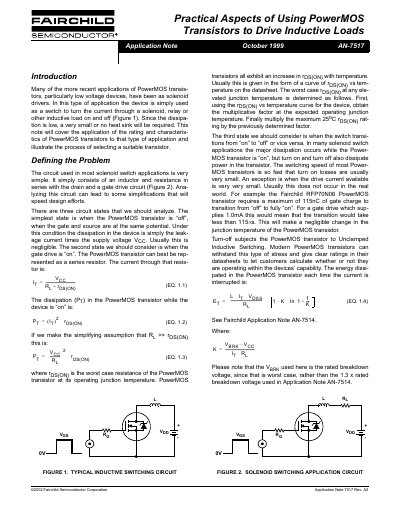

Fairchild Semiconductor AN-7517 Practical Aspects of Using PowerMOS Transistors to Drive Inductive Loads - cover page
Brand
Fairchild
Category
Other Electronics
Document type
Application Note
Language
English
Pages
8
File format
PDF
File size
104 KB
Published
12 July, 2012
Updated
30 September, 2023
MD5 checksum
D5FFE42E240464AB2E164B30D3C0FC87

About this manual

This document provides a guide on the practical application of PowerMOS transistors as switches for inductive loads, such as solenoids and relays. It details the circuit states involved, including the 'off' state leakage, the 'on' state conduction, and the switching transitions.

What's inside

  • Introduction
  • Defining the Problem
  • Analyzing the Circuit
  • Power Dissipation Calculations
  • UIS Capability Check
  • Example 1: Device Selection
  • Thermal Resistance Calculations

Frequently asked questions

What is the maximum gate charge required for the Fairchild RFP70N06 PowerMOS transistor?

The device requires a maximum of 115nC of gate charge to transition from off to fully on.

How long does it take for the RFP70N06 transistor to switch when driven by a 1.0mA current?

With a 1.0mA drive, the transition would take less than 115 µs.

What is the maximum junction temperature limit for the devices tested in Example 1?

The calculations assume a junction temperature of 175oC to verify suitability.

Download PDF (104 KB)

More Fairchild Manuals


View all Fairchild manuals →