
This document describes a simple and inexpensive method to synchronize a fixed frequency PWM controller to a wide range of frequencies (>2x). It explains why synchronization is needed and presents a popular method of single frequency synchronization, along with its limitations. It then covers the topic of wide frequency range synchronization and presents a block diagram using a novel approach based on a phase locked loop (PLL). A practical design example is provided, complete with design formulas and a schematic for synchronizing the ML4824-1 to any frequency in the 25kHz to 75kHz range. The circuit presented can be used with any controller using a RC generated voltage ramp for the oscillator.
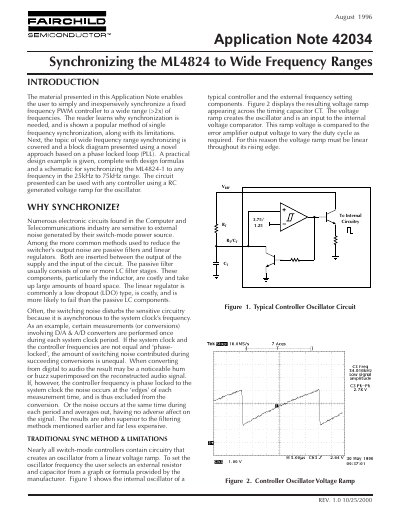
The document addresses the need for synchronizing switch-mode power supply controllers with sensitive electronic circuits, such as D/A and A/D converters, to reduce switching noise. It critiques traditional single-frequency synchronization methods for their limited locking range (<1.2:1) and voltage ramp corruption.
A novel approach using a Phase Locked Loop (PLL) is presented to allow the controller's oscillator to function as a Voltage Controlled Oscillator (VCO). This method enables synchronization across a wide frequency range, specifically demonstrated with a design example for the ML4824-1 operating between 25kHz and 75kHz.
| Synchronized Frequency Range (Example) | 25kHz to 75kHz |
|---|---|
| Traditional Sync Locking Range Limitation | <1.2:1 |
It has a limited locking range of less than 1.2:1 and can corrupt the voltage ramp waveform.
The circuit allows synchronization to any frequency between 25kHz and 75kHz without requiring hardware changes.
When the sync input frequency exceeds the controller's frequency, the comparator supplies more charge current to CT via Q1 and R4.
The phase comparator output goes low, which reduces the controller's operating frequency until it matches the sync signal.