
This instruction sheet tells how to install your EP-15 Fluid Level sensor and connect it to a NMEA 2000 network using LowranceNET network components.
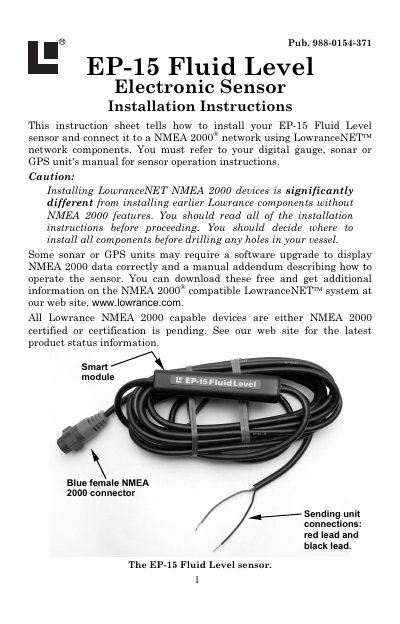
This document provides installation instructions for the Lowrance EP-15 Fluid Level Electronic Sensor. It details how to connect the sensor to a NMEA 2000 network using LowranceNET components and explains the necessary steps for wiring the sensor to a sending unit (fluid level arm or potentiometer). Users are advised to consult their digital gauge, sonar, or GPS unit manual for specific operation instructions.
The guide covers the physical components of the sensor, including the smart module and cable lengths, and explains how to integrate the device into an existing NMEA 2000 network backbone using T-connectors. It also includes safety cautions regarding fuel tank installations and warranty information provided by Lowrance Electronics.
| Cable length (connector to smart module) | 18 inches (46 cm) |
|---|---|
| Cable length (smart module to bare wires) | 10 feet (3 meters) |
The EP-15 sensor is most commonly used in fuel tanks but can monitor fluid levels in live wells, oil reservoirs, fresh water, gray water, or black water tanks.
Yes, if this is the first sensor being connected to the network, a LowranceNET Node Kit is required as a one-time purchase.
Yes, the smart module converts fluid level information to NMEA 2000 data format, allowing any digital gauge, sonar, or GPS unit connected to the NMEA 2000 network to display the fluid level.