
The MC10E/100E211 is a low skew 1:6 fanout device designed explicitly for low skew clock distribution applications. The device can be driven by either a differential or single-ended ECL or, if positive power supplies are used, PECL input signal (PECL is an acronym for Positive ECL, PECL levels are ECL levels referenced to +5V rather than ground). If a single-ended input is to be used the VBB pin should be connected to the CLK input and bypassed to ground via a 0.01µF capacitor. The VBB supply is designed to act as the switching reference for the input of the E211 under single-ended input conditions, as a result this pin can only source/sink up to 0.5mA of current.
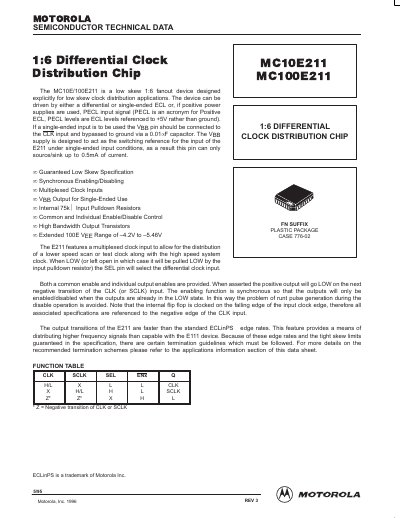
The Motorola MC10E211 and MC100E211 are low skew 1:6 fanout devices designed explicitly for low skew clock distribution applications. They can be driven by either a differential or single-ended ECL input signal, or if positive power supplies are used, a PECL (Positive ECL) input signal.
Key features include synchronous enabling/disabling of outputs to avoid runt pulse generation during disable operations, multiplexed clock inputs for distributing lower speed scan clocks alongside high-speed system clocks, and internal 75kΩ input pulldown resistors. The devices offer both common and individual enable/disable control with high bandwidth output transistors.
| Package Type | 28-Lead PLCC |
|---|---|
| Case Number | CASE 776-02 |
| Input Pulldown Resistance | Internal 75kΩ |
It is designed explicitly for low skew clock distribution applications.
Yes, if positive power supplies are used, it can accept PECL (Positive ECL) input signals.
Outputs are enabled/disabled only when they are already in the LOW state to avoid runt pulse generation.