
MC10E/100E131 is a quad master-slave D-type flip-flop with differential outputs, released by Motorola in 1996. The device can be clocked separately by keeping the common clock (CC) low and using the clock enable (CE) inputs for clocking. Common clocking is achieved by keeping the CE inputs low and using CC to clock all four flip-flops. In this case, the CE inputs perform the function of controlling the common clock to each flip-flop. Individual asynchronous resets are provided (R). Asynchronous set controls (S) are ganged together in pairs, with the pairing chosen to reflect physical chip symmetry. Data enters the master when both CC and CE are LOW, and transfers to the slave when either CC or CE (or both) go HIGH.
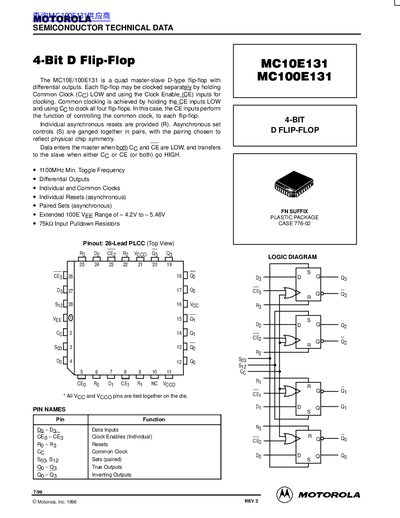
The document describes the MC10E/100E131, a quad master-slave D-type flip-flop featuring differential outputs. It supports both individual clocking via Clock Enable (CE) inputs and common clocking using a Common Clock (CC). The device includes asynchronous resets for each flip-flop and paired asynchronous set controls.
| Max Toggle Frequency (MC10E) | 1100 MHz Min. |
|---|---|
| Package Type | 28-Lead PLCC |
| Operating Voltage Range (MC10E) | -4.2V to 5.46V |
| Input Pulldown Resistors | 75kQ |
Each flip-flop may be clocked separately by holding Common Clock (CC) LOW and using the Clock Enable_ (CE) inputs for clocking.
Common clocking is achieved by holding the CE inputs LOW and using CC to clock all four flip-flops.
The MC10E/100E131 is a quad master-slave D-type flip-flop with differential outputs.