
BTA12 BW/CW BTB12 BW/CW is a high-performance glass passivated chip technology triac family from STMicroelectronics. This triac family has excellent switching performance and is suitable for applications such as phase control and static switching on inductive or resistive loads.
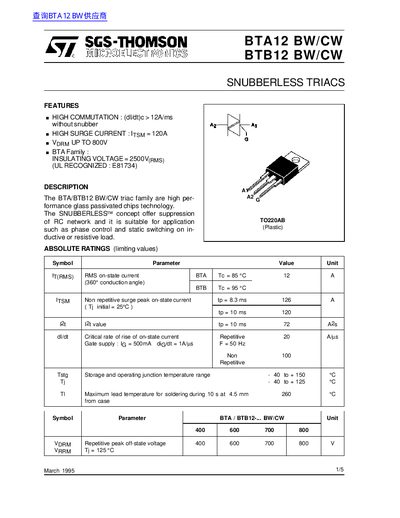
This document provides technical specifications for the BTA12 BW/CW and BTB12 BW/CW snubberless triac family. These high-performance glass passivated chips are designed for phase control and static switching applications on inductive or resistive loads without the need for an RC snubber network. The devices support a surge current of 120A and a repetitive peak off-state voltage up to 800V.
| RMS on-state current (BTA) | 12 A |
|---|---|
| Non repetitive surge peak on-state current | 126 A |
| Critical rate of rise of on-state current | 20 A/us |
| Storage and operating junction temperature range | - 40 to+ 150 °c |
| Maximum lead temperature for soldering | 260 °c |
| Repetitive peak off-state voltage | 400 to 800 V |
| Junction to ambient thermal resistance | 60 °CiW |
| Junction to case thermal resistance (DC) | 3.3 °C/W |
| Gate trigger current (MIN) | 2 mA |
| Gate trigger voltage (MAX) | 1.5 Vv |
| Package type | TO220AB Plastic |
No, the SNUBBERLESS concept offers suppression of the RC network.
The maximum surge current is 120A.
The maximum repetitive peak off-state voltage is up to 800V.