
BAT 14-099 is a low noise silicon dual Schottky diode, suitable for DBS mixer applications with operating frequencies up to 12 GHz.
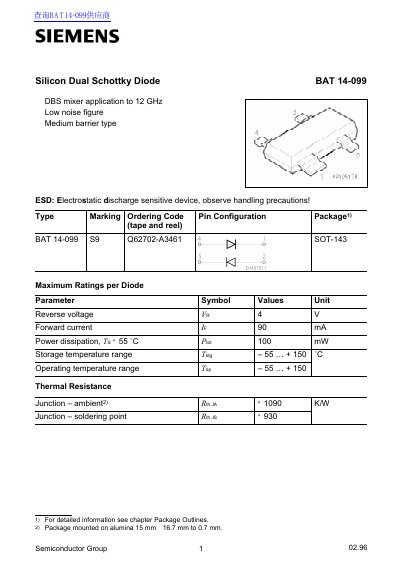
This document is a datasheet for the Siemens BAT 14-099, a Silicon Dual Schottky Diode designed for DBS mixer applications up to 12 GHz. Key features include a low noise figure and a medium barrier type construction. The device is ESD sensitive and requires careful handling precautions.
The datasheet provides detailed specifications including maximum ratings such as a reverse voltage of 4 V and a forward current of 90 mA. It also lists electrical characteristics like breakdown voltage, forward voltage, and diode capacitance at 25 °C, along with typical impedance characteristics across a frequency range from 1 GHz to 12 GHz.
| Reverse voltage | 4 V |
|---|---|
| Forward current | 90 mA |
| Power dissipation | 100 mw |
| Storage temperature range | -55...+150 °C |
| Operating temperature range | -55 ...+ 150 |
| Breakdown voltage | 4 V |
| Forward voltage (Ik=1mA) | 0.43 V |
| Forward voltage (Ie=10mA) | 0.55 V |
| Diode capacitance | 0.35 pF |
The maximum reverse voltage rating is 4 V.
The forward current rating is 90 mA.
The operating temperature range is from -55 °C to +150 °C.
The typical diode capacitance is 0.35 pF at Va =0 and f= 1 MHz.