
The BLF378 is a VHF push-pull power MOS transistor produced by Philips. It features high power gain, easy power control, good thermal stability and excellent reliability.
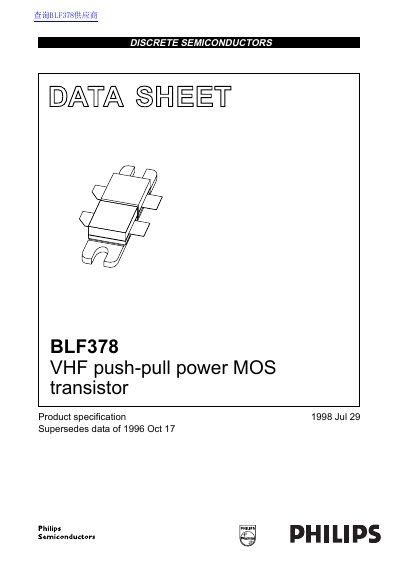
The document describes the Philips BLF378, a discrete semiconductor component featuring high power gain and good thermal stability. It is a dual push-pull silicon N-channel enhancement-mode vertical D-MOS transistor encapsulated in a 4-lead SOT262A1 balanced flange package with two ceramic caps.
Key specifications include a maximum drain-source voltage of 110 V, a total power dissipation of 500 W (at Tj < 25 °C), and an operating frequency range suitable for CW class-AB operation up to at least 225 MHz. The device is intended for broadcast transmitter applications in the VHF frequency range.
| Drain-source voltage (Voss) | 110 V |
|---|---|
| Gate-source voltage (Vass) | +20 V |
| Drain current (DC) (Ib) | 18 A |
| Total power dissipation (Prot) | 500 W |
| Storage temperature (Tstg) | -65 to 150 °C |
| Junction temperature (Tj) | 200 °C |
| Forward transconductance (Dis) | 4.5 to 6.2 S |
| Drain-source on-state resistance (Rogon) | 0.2 to 0.3 Ω |
The maximum junction temperature (Tj) is 200 °C.
The maximum total power dissipation is 500 W when the junction temperature is below 25 °C and both sections are equally loaded.
The maximum drain-source voltage is 110 V.
Yes, the BLF378 can withstand a load mismatch corresponding to VSWR = 7 : 1 under specific operating conditions.