
This document introduces the method of using Agilent Bravo Automated Liquid Handling Platform for accurate serial dilution. The platform has a full channel head, which can achieve efficient mixing, no tip changes are required, and no wash steps are required.
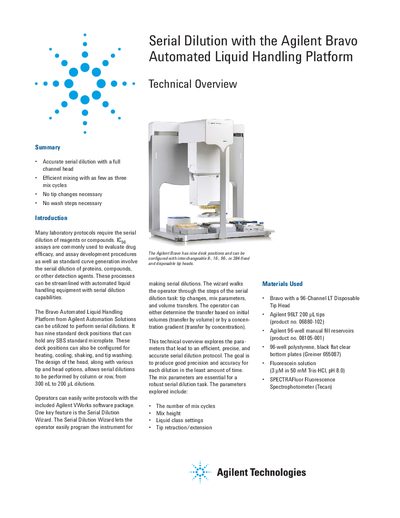
This document provides a technical overview of performing serial dilutions on the Agilent Bravo Automated Liquid Handling Platform. It describes the setup using 96-well plates and reservoirs, along with specific parameters for aspiration and dispensing to ensure accuracy.
The guide presents experimental results analyzing how different mix cycle counts (ranging from 3 to 20) and mix heights affect precision and accuracy. It concludes that while more cycles improve precision, a balance must be struck between efficiency and result quality.
Three mix cycles yield an average precision of 11.8%.
A 3 mix cycle protocol takes less than six minutes, while a 20 mix cycle protocol takes 20 minutes.
The average precision is 3.9% at a mix height of 3 mm.