
Agilent 500 Ion Trap LC/MS Atmospheric Pressure Ionization Interface Technical Overview

The document introduces the features and characteristics of Agilent 500 Ion Trap LC/MS Atmospheric Pressure Ionization Interface, including electrospray assembly, liquid capillary, tilted chamber and tilted ion guide.

Agilent 500 Ion Trap LC/MS Atmospheric Pressure Ionization Interface Technical Overview - cover page
Brand
Agilent
Document type
Product Leaflet
Language
English
Pages
4
File format
PDF
File size
712 KB
Published
05 July, 2012
Updated
30 September, 2023
MD5 checksum
4288AB43F92BC4BEEB631743BAF21871

About this manual

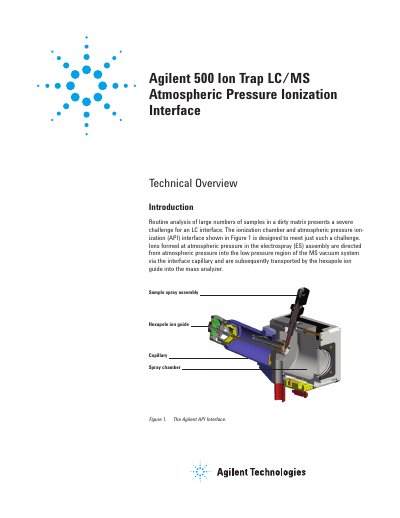
The document provides a technical overview of the Agilent 500 Ion Trap LC/MS Atmospheric Pressure Ionization (API) interface. It describes how ions formed at atmospheric pressure in the electrospray assembly are directed into the low-pressure region of the mass spectrometer vacuum system via an interface capillary and transported by a hexapole ion guide.

What's inside

  • Introduction
  • Sample spray assembly
  • Hexapole ion guide
  • Product Description
  • Tilted chamber design
  • Heated counter-flow drying gas
  • Experimental Conditions and Results
  • Benefits

Frequently asked questions

What evidence is provided regarding long-term contamination?

One thousand consecutive injections showed no indication of contamination or changes in system sensitivity.

What is the Agilent 500 Ion Trap LC/MS Atmospheric Pressure Ionization Interface designed to do?

It is designed to meet the challenge of routine analysis of large numbers of samples in a dirty matrix.

How many consecutive injections were performed in the reproducibility test shown in Figure 4?

One thousand consecutive injections were made with the results shown in Figure 4.

What was the percentage relative standard deviation (%RSD) for the area response after 1000 injections?

The %RSD for the area response was 10.0% after 1000 injections.

Download PDF (712 KB)

More Agilent Manuals


View all Agilent manuals →