
This document details the performance characteristics of the Agilent 1200 Series LC system, including performance evaluation steps, module-specific and complete system performance evaluation methods, and sample selection related to system evaluation. Different separation methods were used to evaluate the module-specific and complete system performance. The results showed that the performance of the pump, autosampler, and detector are related to the system configuration, while baseline noise and precision of retention times and peak areas are affected by the complete system.
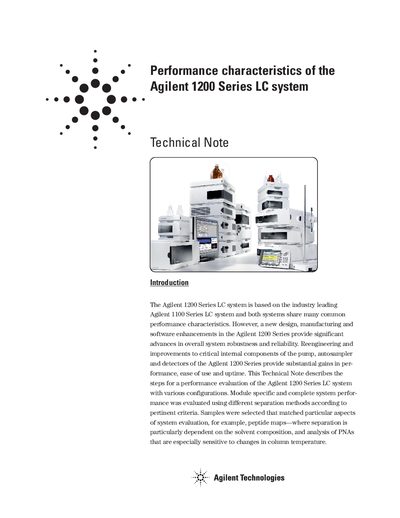
This document serves as a technical note describing the steps for evaluating the performance of the Agilent 1200 Series LC system. It highlights significant advances in robustness, reliability, ease of use, and uptime compared to previous systems like the Agilent 1100 Series.
The evaluation covers various module configurations including vacuum degassers, isocratic and high-pressure binary pumps, low-pressure quaternary pumps, autosamplers, thermostatted column compartments, and UV-Vis detectors. Key measurements such as baseline noise, delay volume, composition accuracy, retention time precision, and temperature stability are analyzed to demonstrate system capabilities.
| Flow rate range (Low-pressure quaternary pump) | 0 to 10 mL/min |
|---|---|
| Injection volume range (High performance autosampler) | 0.5 up to 100 pL |
| Column compartment temperature range | 10 °C below ambient up to 80 °C |
| Delay volume (Quaternary pump) | approximately 800 to 1100 pL |
| Delay volume (Binary pump, no mixer) | about 180 to 480 pL |
| Delay volume (Binary pump, with mixer) | 600 to 900 pL |
Agilent ChemStation software was used for instrument control, data acquisition and evaluation.
The precision for retention time is typically < 0.1 %.
For this type of application, the precision for areas is typically < 2%.