
Agilent High Efficiency Columns with LC/MS Technical Overview

This document introduces the use of Agilent high efficiency columns with LC/MS
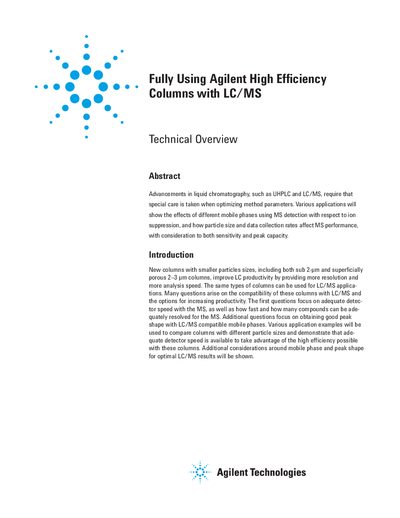

Agilent High Efficiency Columns with LC/MS Technical Overview - cover page
Brand
Agilent
Document type
Product Leaflet
Language
English
Pages
16
File format
PDF
File size
2.1 MB
Published
05 July, 2012
Updated
30 September, 2023
MD5 checksum
4305B75CD9B2A65682EA8A75DD273035

About this manual

This document provides a technical overview of using Agilent high-efficiency liquid chromatography columns in conjunction with mass spectrometry (LC/MS). It addresses the compatibility of small particle size columns with MS detectors and demonstrates how they improve resolution and analysis speed.

The text compares different column technologies, including totally porous particles (1.8 µm and 3.5 µm) and superficially porous particles (2.7 µm), using experimental data from Agilent RRLC and Infinity LC systems coupled with Triple Quadrupole Mass Spectrometers.

What's inside

  • Technical Overview
  • Experimental Setup
  • Different particle sizes with MS detection
  • Comparison of superficially porous and totally porous performance
  • Shorter columns analysis

Frequently asked questions

What is the recommended maximum flow rate for using an ESI source with a G6410A MS?

It is not considered good practice to use this mass spectrometer with an ESI source at a flow rate of 2.75 mL/min.

What pressure range should be used for the Agilent ZORBAX Eclipse Plus C18 3.5 µm column?

This column is ideal for performing analysis on an instrument operating at 400 bar.

What pressure range should be used for the Agilent Poroshell 120 EC-C18 2.7 µm column?

This column works best on an instrument operating at 600 bar.

Download PDF (2.1 MB)

More Agilent Manuals


View all Agilent manuals →