
Agilent Poroshell 300SB-C3 is a unique microparticulate superficially-porous C3 column packing from Agilent. Columns of this material are especially useful for carrying out ultra-fast gradient separations of macromolecules because of the favorable kinetic properties of the special silica support. Very rapid gradient separation of proteins, poly-peptides and related bio-macromolecules is attained by operating these columns at high flow rates (mobile phase velocities); rapid mass transfer maintains good column efficiency for excellent separations. This StableBond (SB) packing is made by covalently bonding a patented sterically-protected C3 stationary phase to the specially prepared, high-purity Poroshell 300 microparticles. The special silica support is designed to reduce or eliminate strong adsorption of basic compounds, and is especially friendly towards biomolecules such as proteins. The densely covered, sterically-protected triisopropylsilane stationary phase allows these particles to be routinely used at low pH (for example, pH 1) and temperatures to at least 70 °C with excellent stability. Therefore, a Poroshell 300SB-C3 is particularly well suited for use with aggressive mobile phases that are widely used for the reversed-phase separation of proteins and other such biomacromolecules (for example, pH < 2, high ionic strength, ion-pair additives, and so forth). This packing also is useful for separating compounds such as proteins.
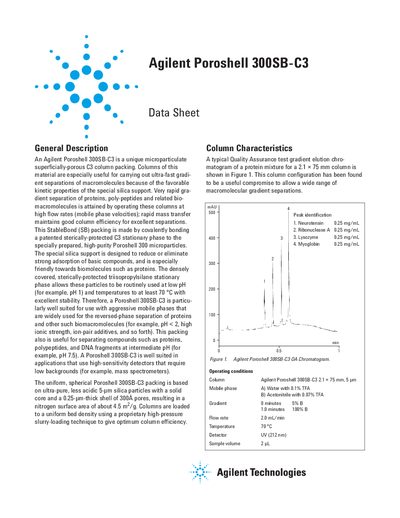
The Agilent Poroshell 300SB-C3 is a unique microparticulate superficially-porous C3 column packing designed for ultra-fast gradient separations of macromolecules. It features a stable silica support with a 0.25-µm-thick shell of 300Å pores and a sterically-protected triisopropylsilane stationary phase. This design allows for high flow rates and excellent stability at low pH (e.g., pH 1) and temperatures up to 70 °C, making it suitable for aggressive mobile phases used in protein and peptide reversed-phase separations.
The document provides detailed operating guidelines, safety considerations, and column care instructions. It specifies that the column is compatible with water and common organic solvents but should not be used below pH 0.9 or above pH 8.0. Recommended systems for UHPLC separations include the Agilent 1260 Infinity, 1260 Infinity Bio-inert, or 1290 Infinity LC systems. The datasheet also lists specific ordering information for various column dimensions and guard columns.
| Shell Thickness | 0.25 µm |
|---|---|
| Pore Size | 300 Å |
| Nitrogen Surface Area | 4.5 m²/g |
| Maximum Operating Pressure | 400 bar (6,000 psi) |
| Max Temp (pH < 5) | 70 °C |
| Max Temp (pH 5-8) | 40 °C |
| Inlet Frit Porosity | 2 µm |
The maximum operating temperature is 70 °C.
The Agilent 1260 Infinity, 1260 Infinity Bio-inert, or 1290 Infinity LC systems are recommended.
Long-term storage should be in a pure organic solvent, preferably 100% acetonitrile.