
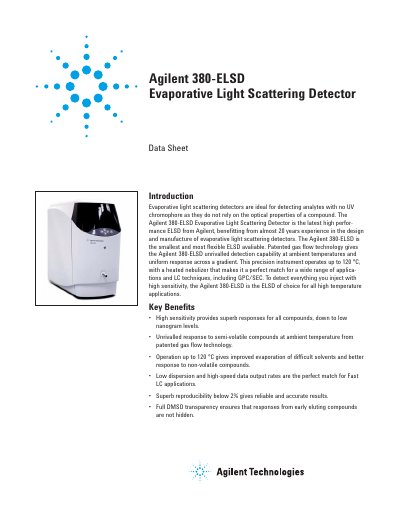
The Agilent 380-ELSD is a high-performance evaporative light scattering detector designed for detecting analytes with no UV chromophore. It utilizes patented gas flow technology to provide unrivalled detection capability at ambient temperatures and uniform response across a gradient. The instrument operates up to 120 °C with a heated nebulizer, making it suitable for a wide range of applications including GPC/SEC and high-temperature LC techniques.
| Operating Temperature | up to 120 °C |
|---|---|
| Reproducibility | below 2% |
| Detection Range | low nanogram levels |
It is ideal for detecting non-volatile compounds, where temperatures of 100 °C or above are required.
No, control and digital data collection come as standard for multi-vendor platforms, so there is no need for an analog to digital converter.
It uses a carefully controlled stream of gas to the evaporation step to enable complete removal of DMSO without increasing the operating temperature.