
This document describes how to use small sample injection volumes in size exclusion chromatography
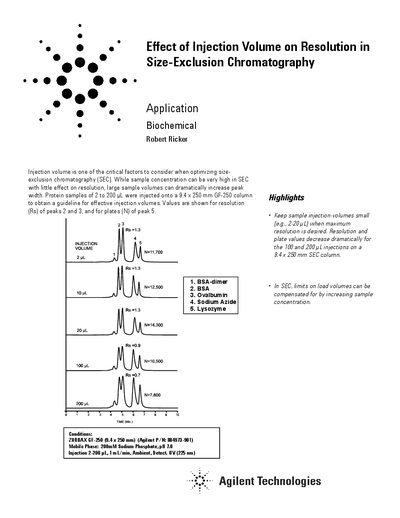
This document serves as a guideline for optimizing size-exclusion chromatography (SEC) by examining the impact of injection volume on peak width and resolution. It presents data obtained from injecting protein samples ranging from 2 to 200 pL onto a ZORBAX GF-250 column. The study highlights that while sample concentration can be high, large sample volumes significantly increase peak width and reduce resolution.
| Column | ZORBAX GF-250 (9.4 x 250 mm) |
|---|---|
| Mobile Phase | 200mM Sodium Phosphate, pH 7.0 |
| Flow Rate | 1 mL/min |
| Detection | UV (225 nm) |
Sample injection volumes should be kept small, for example between 2 and 20 uL, when maximum resolution is desired.
Sample concentration can be very high in SEC with little effect on resolution.
Resolution and plate values decrease dramatically for 100 and 200 pL injections on a 94 x 250 mm SEC column.