
This experiment report introduces the effect of column length on efficiency and resolution. When appropriate, two or more SEC columns may be connected in series to achieve a desired separation.
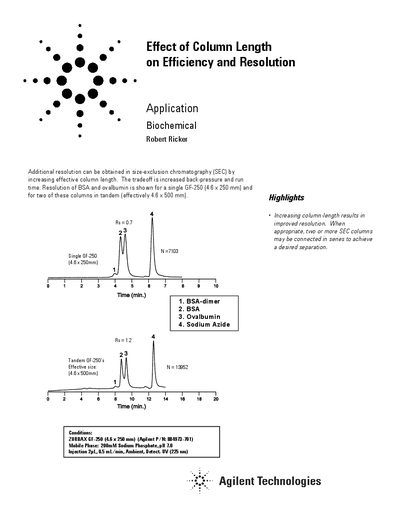
The document explains that additional resolution can be achieved in size-exclusion chromatography (SEC) by increasing the effective column length. It demonstrates this principle by comparing a single GF-250 column with two GF-250 columns connected in tandem.
The study highlights the tradeoff involved: while longer columns improve separation, they also increase back-pressure and run time. The note provides specific chromatographic conditions used for the demonstration.
Increasing column length results in improved resolution, allowing two or more columns to be connected in series for desired separation.
Connecting two GF-250 columns in tandem creates an effective size of 4.6 x 500 mm.
The test uses 200mM Sodium Phosphate at pH 7.0 with a flow rate of 0.5 mL/min.