
This article describes a high-performance liquid chromatography analysis method for quality control of heparins. Heparins are mucopolysaccharides used to prevent thrombolysis in cases of hyperlipidemia, arteriosclerosis, blood transfusions, and operations. The analysis was conducted using an Agilent 1100 Series GPC-SEC system, which includes a vacuum degasser, thermostatted column compartment, refractive index detector, and other equipment. The results indicate that the method has high analytical accuracy and stability.
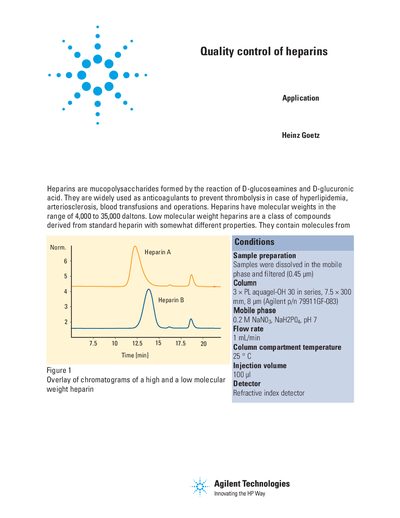
Heparins are mucopolysaccharides widely used as anticoagulants. This document details their molecular weight range from 4,000 to 35,000 daltons and distinguishes between standard heparin and low molecular weight variants.
The note outlines an HPLC method for characterizing these compounds using the Agilent 1100 Series GPC-SEC system. It includes specific conditions such as column specifications (PL aquagel-OH), mobile phase composition, flow rate, temperature, and injection volume to determine molecular weight distributions.
Heparins are used as anticoagulants to prevent thrombolysis in cases of hyperlipidemia, arteriosclerosis, blood transfusions, and operations.
Heparins have molecular weights in the range of 4,000 to 35,000 daltons.
The flow rate must be set to 1 mL/min.