
This Application Note demonstrates mass-based purification of a series of synthetic peptides with the Agilent 1100 Series purification system. The modular set-up of the system, a reliable fully-automated delay volume calibration and a comprehensive software package provide a versatile platform for purification tasks up to 100 mL/min. Crude peptides were successfully purified by reverse phase HPLC from less than 1 kDa to more than 10 kDa, covering a pI range from 4 to 13.
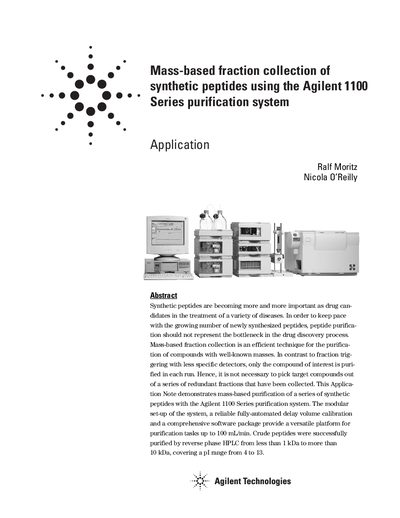
This document describes a technique for purifying synthetic peptides using mass-based fraction collection with the Agilent 1100 Series purification system. Unlike UV-based methods that collect redundant fractions, this approach triggers collection only when the specific mass of the target compound is detected, improving efficiency and saving resources.
The note details the instrumental setup, including preparative pumps, an autosampler, a column organizer, a diode array detector, an active splitter, and a high-performance LC/MSD system. It explains how the active splitter functions to route small aliquots to the mass spectrometer while maintaining the main flow to the fraction collector, and discusses the benefits of using formic acid in the make-up flow to enhance sensitivity.
| Flow rate capability | up to 100 mL/min |
|---|---|
| Peptide mass range | less than 1 kDa to more than 10 kDa |
| Peptide pI range | 4 to 13 |
| Split ratio range | 10:1 to 300,000:1 |
Only the compound of interest is purified in each run, eliminating the need to pick target compounds out of redundant fractions.
It transfers small aliquots of the HPLC main flow to the mass spectrometer while keeping the main flow for the fraction collector.
Formic acid provides good signals in the mass spectrometer, whereas TFA suppresses ionization and gives poor sensitivity.