
This application note describes how the attributes of Time of Flight and Trap mass spectrometry can be combined to provide a highly reliable identification for an unknown compound. Time of Flight mass spectrometry provides a very accurate mass for the parent compound, and Trap mass spectrometry provides fragmentation data; together they greatly diminish the number of candidate compounds, and increase the confidence in a confirmation.
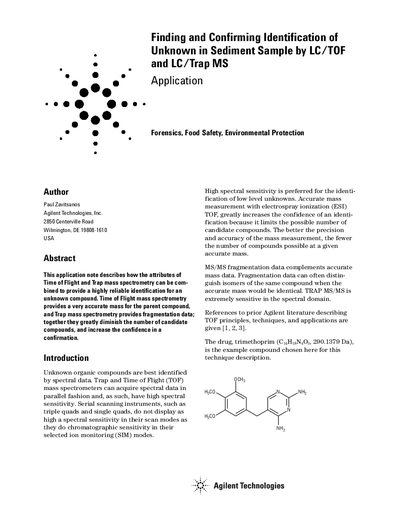
The document explains how combining Time of Flight (TOF) and Trap mass spectrometry attributes provides reliable identification for unknown organic compounds. TOF offers accurate parent compound mass, while Trap MS/MS provides fragmentation data to distinguish isomers and confirm identity.
Using trimethoprim as an example found in a lake sediment sample, the text details experimental conditions including LC gradients and MS parameters. It demonstrates how accurate mass measurement narrows candidate lists and how subsequent MS/MS analysis confirms the specific compound by matching diagnostic ion transitions.
The retention time for trimethoprim in the 20-drug standard is 2.11 minutes.
Mobile phase A is 10mM ammonium formate at pH 4.5, and Mobile phase B is acetonitrile.