
Antibodies are a class of proteins that play a key role in immunological interactions. They bind to antigens (proteins, glycoproteins, DNA, etc.) with high specificity. Antibodies have high value in diagnostics, research, and therapeutics. IgG is a class of antibodies consisting of two heavy chains (50 kDa each) and two light chains (25 kDa each) attached through disulfide bridges. While the carboxy-terminal domains are conserved, the amino-terminal domains have variable amino acid sequences, resulting in the molecule's specificity and diversity. Most antibodies are glycosylated, further increasing molecular diversity. Treatment of intact antibodies with chemicals and enzymes allows specific cleavage of the heavy and light chains, removal of carbohydrate moieties, and cleavage of the polypeptide chains, enabling the study of a particular antibody's structure. Rapid HPLC method development and analysis using ZORBAX Poroshell technology are valuable tools for investigating antibody structure. Rapid HPLC analysis of monoclonal antibody IgG1 light chains using ZORBAX Poroshell 300SB-C8.
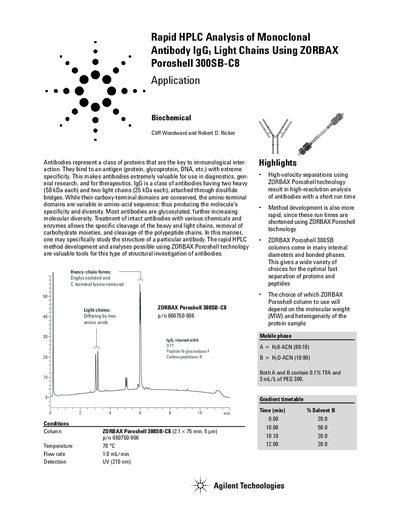
Agilent Technologies presents an application demonstrating the use of ZORBAX Poroshell technology for the rapid analysis of monoclonal antibodies. The document details a high-velocity separation method optimized for distinguishing between antibody light chains that differ by only two amino acids, as well as separating heavy-chain forms.
The technique utilizes a ZORBAX Poroshell 300SB-C8 column with specific mobile phase conditions and a gradient timetable to achieve complete analysis in less than 10 minutes. The method allows for the quantitation of chain forms, monitoring of enzymatic reactions, and isolation of antibody chains for downstream use.
| Mobile phase A composition | H2O-ACN (90:10) |
|---|---|
| Mobile phase B composition | H2O-ACN (10:90) |
| Additives in mobile phases | 0.1% TFA and 3 mL/L of PEG 300 |
| Column temperature | 70°C |
| Flow rate | 1.0 mL/min |
| Detection wavelength | UV (210 nm) |
The analysis is complete in less than 10 minutes.
Yes, optimization of the gradient profile allows distinguishing between light chains differing only in the identity of two amino acids.
It facilitates rapid analysis and method development by allowing increased flow rates without significant peak broadening.