
This document describes an LC system for online 2D LC/MS, which uses an effective continuous salt solution gradient in the first dimension. The results will be compared to previously obtained results.
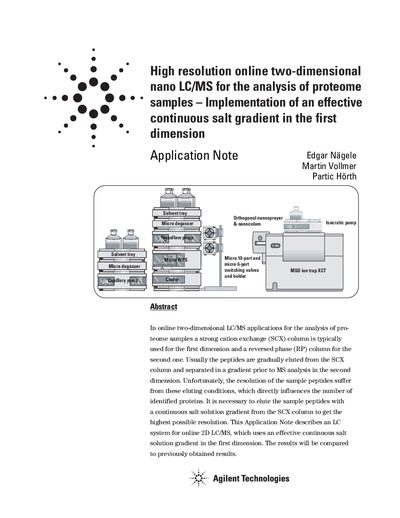
The document details a liquid chromatography system designed for the high-resolution analysis of complex proteome samples. It focuses on implementing an effective continuous salt solution gradient in the first dimension (Strong Cation Exchange) to improve peptide resolution compared to traditional intermittent elution methods.
The setup utilizes Agilent 1100 Series nanoflow and capillary pumps alongside a 11100 Series isocratic pump. The system employs a specific valve configuration involving micro 6-port and 10-port valves, along with enrichment columns (Agilent BioSCX Series II) and analytical columns (ZORBAX 300SB C18), to automate the separation workflow.
Using a continuous salt solution gradient is necessary to get the highest possible resolution of sample peptides, which directly influences the number of identified proteins.
The salt gradient proceeds up to 50 mM NaCl, though the majority of peptides are eluted with a concentration up to about 150 mM NaCl.
The nanoflow gradient starts with 5 % acetonitrile and increases up to 65 % acetonitrile with a slope of 1 %/min for each RP analysis.