
This application is a tool to aid RNA data interpretation and identify features from total RNA electropherograms that reveal information about RNA sample quality.
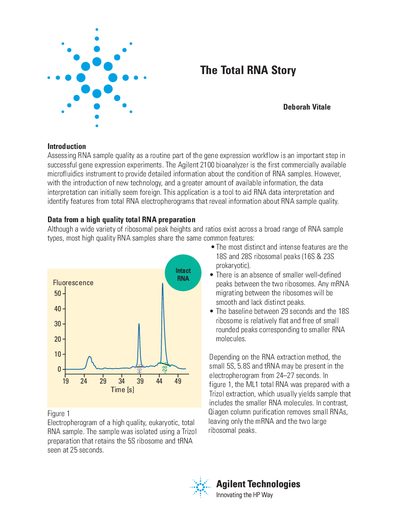
This document serves as a guide for interpreting RNA data from the Agilent 2100 Bioanalyzer. It details the common features of high-quality total RNA samples, such as distinct 18S and 28S ribosomal peaks and a flat baseline, contrasting them with samples containing small RNA molecules like tRNA and 5S ribosomes.
The text further describes the visual indicators of RNA degradation, including peak shifts to the left, jagged baselines, and the appearance of defined peaks from degraded fragments. It provides examples of electropherograms for high-quality eukaryotic and prokaryotic samples, as well as partially and fully degraded prokaryotic samples.
The most highly degraded products have a migration time between 22 and 24 seconds.