
This compendium describes the applications of the Agilent LC/MSD TOF technology in the pharmaceutical industry, focusing on the advantages of high resolution, high accuracy, and wide dynamic range TOF mass spectrometry in drug development.
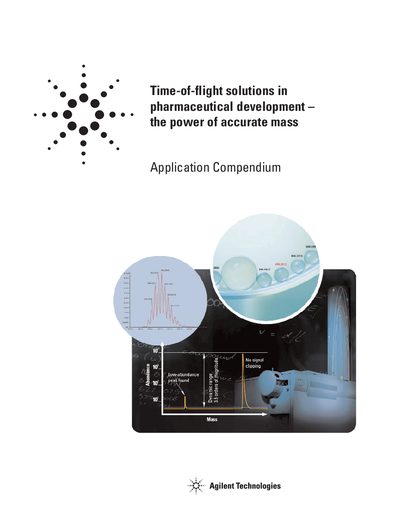
This document is an application compendium focusing on the Agilent LC/MSD time-of-flight (TOF) mass spectrometer. It highlights the instrument's ability to provide routine mass accuracy of 3 ppm or better and full scan sensitivity at the low picogram level.
The text covers various aspects of TOF technology, including basic theory of operation for orthogonal acceleration instruments, flight time equations, and dynamic range considerations. Specific applications discussed include identifying unknown compounds, automated empirical formula confirmation, analyzing drugs of abuse, and structure elucidation of degradation products.
| Mass Accuracy | 3 ppm or better |
|---|---|
| Sensitivity | low picogram level |
| Dynamic Range | three orders of magnitude |
The instrument provides routine mass accuracy of 3 ppm or better over a broad dynamic range.
The instrument provides a routine mass accuracy of 3 ppm or better over a broad dynamic range.
The flight tube used for ion analysis is about one meter in length.
The front of the detector and flight tube are at roughly -6,500 volts while the PMT output is at ground potential.