
This Application Note describes the methods for metabolite identification using the different scan modes available with the Agilent 6410B Triple Quadrupole LC/MS system, as well as the use of the Agilent 1200 Series Rapid Resolution LC (RRLC) system for separation of compounds in complex mixtures on Agilent ZORBAX Rapid Resolution High Throughput (RRHT) columns with 1.8 µm particle size. It also discusses the use of the Agilent MassHunter Workstation software for data acquisition and qualitative data analysis.
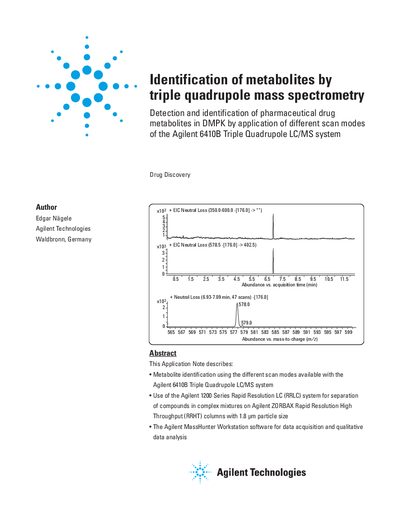
This document details the use of the Agilent 6410B Triple Quadrupole LC/MS system for detecting and identifying pharmaceutical drug metabolites. It explains the operation of the triple quadrupole instrument, which consists of three quadrupoles where Q1 and Q3 act as mass filters and Q2 acts as a collision cell for fragmentation.
The note covers specific scan modes including full scan, selected ion monitoring (SIM), product ion scan, precursor ion scan, neutral loss scan, and multiple reaction monitoring (MRM). It provides experimental details for analyzing the parent drug buspirone and its metabolites using the Agilent 1200 Series Rapid Resolution LC system and MassHunter Workstation software.
| Column dimensions | 2.1 x 150 mm |
|---|---|
| Particle size | 1.8 um |
| Flow rate | 0.5 mL/min |
| Column oven temperature | 50 C |
| Source mode | Electrospray (ESI) in positive mode |
| Dry gas flow | 12.0 L/min |
| Dry temperature | 350 C |
| Capillary voltage | 3000 V |
| Fragmentor voltage | 180 V |
| Skimmer voltage | 60V |
| Collision energy | 30 eV |
| Mass range | 50-1000 |
The quadrupole in the middle (Q2) acts as a collision cell for molecular fragmentation and generation of MS/MS information.
The Agilent MassHunter Workstation software is used for data acquisition and qualitative data analysis.