
This Application Note describes the identification of pharmaceutical metabolites using the Agilent 6520 Accurate-Mass Quadrupole Time-of-Flight (Q-TOF) LC/MS system and Agilent MassHunter Metabolite Identification (MetID) software.
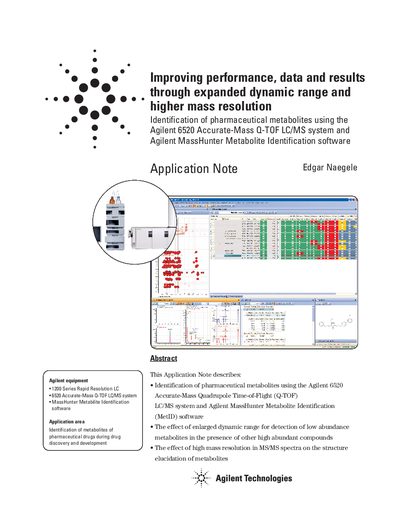
This document details the identification of pharmaceutical metabolites during drug discovery and development. It highlights the benefits of using the Agilent 6520 Accurate-Mass Quadrupole Time-of-Flight (Q-TOF) LC/MS system combined with Agilent MassHunter Metabolite Identification (MetID) software.
| System Model | Agilent 6520 Accurate-Mass O-TOF LC/MS system |
|---|---|
| Software | Agilent MassHunter Metabolite Identification software |
| Column | ZORBAX SB-C18 column, 2.1 x 150 mm, 1.8 pm |
| Flow rate | 0.5 mL/min |
| Mass range | 100-1000 |
| Collision energy | 35 V |
It describes the identification of pharmaceutical metabolites using the Agilent 6520 Accurate-Mass Quadrupole Time-of-Flight (Q-TOF) LC/MS system and Agilent MassHunter Metabolite Identification (MetID) software.
High mass resolution is used to elucidate the structures of metabolites by differentiating between fragments of isobaric mass in MS/MS spectra.