
This article describes the quantification of potential genotoxic impurity D in Atenolol using LC/ESI/MS/MS method with Agilent 1200 Series RRLC and 6410B Triple Quadrupole LC/MS instruments. The developed method is simple, shorter in runtime, with better resolution and higher sensitivity than the existing European and United States Pharmacopeia methods. Agilent's MassHunter Optimization software was used for quick optimization of MS parameters. By connecting the Agilent 6410B Triple Quadrupole (QQQ) LC/MS detector to an Agilent 1200 Series RRLC system, the quantification range can be effectively reduced further down to 5 ppb with a linearity coefficient greater than 0.9992.
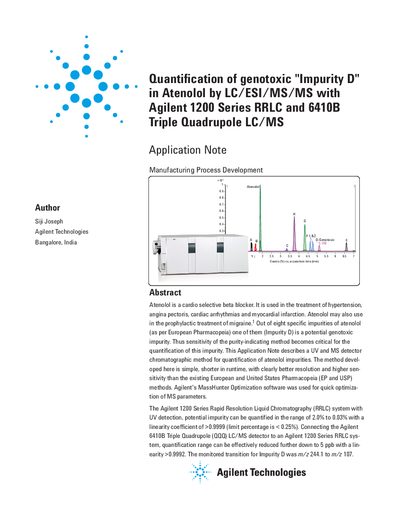
Atenolol is a cardio selective beta blocker used for treating hypertension and other cardiac conditions. One of its specific impurities, Impurity D, is a potential genotoxic impurity, making its quantification critical. This document presents a method developed by Agilent Technologies to quantify this impurity using their 1200 Series Rapid Resolution Liquid Chromatography (RRLC) system with UV detection and a 6410B Triple Quadrupole LC/MS detector.
The developed method offers several advantages over existing European (EP) and United States Pharmacopeia (USP) methods, including a shorter runtime of 7 minutes, better resolution of peaks, and higher sensitivity. The method allows for the quantification of Impurity D in the range of 2.0% to 0.03% using UV detection, and down to 5 ppb using ESI/MS/MS detection. The document details the sample preparation, LC method development, MS parameters, and the results demonstrating the improved performance of the new method.
| Quantification range (UV) | 2.0% to 0.03% |
|---|---|
| Linearity coefficient (UV) | >0.9999 |
| Limit percentage (UV) | < 0.25% |
| Quantification range (MS/MS) | 5 ppb |
| Linearity coefficient (MS/MS) | >0.9992 |
| Monitored transition for Impurity D | m/z 244.1 to m/z 107 |
| Run time (New RRLC method) | 7 minutes |
| Limit of detection (MS/MS) | 3 ppb |
The UV method can quantify the impurity in the range of 2.0% to 0.03%.
The limit of detection for Impurity D using the ESI/MS/MS method is 3 ppb.
The monitored transition for Impurity D is m/z 244.1 to m/z 107.
The new RRLC method has a significantly shorter runtime of 7 minutes compared to the 30 minutes of EP and USP methods.