
This document introduces the application of capillary electrophoresis in peptide analysis, including protein identification, peptide mapping, and purity checking of synthetic peptides. The authors describe the methodological aspects of peptide analysis, including the optimization of protein digestion buffers, electrophoretic conditions, reproducibility, detection sensitivity, and spectral analysis.
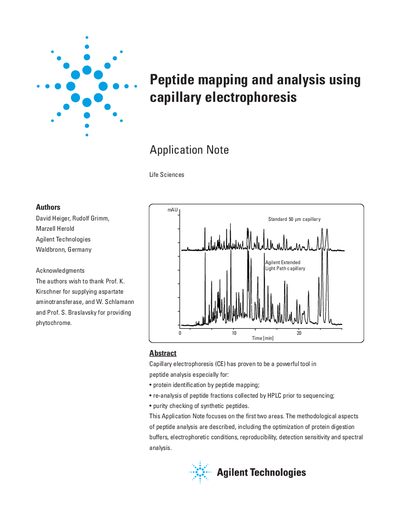
This document details the application of capillary electrophoresis (CE) for peptide analysis, specifically focusing on protein identification via peptide mapping and the re-analysis of peptide fractions collected by HPLC. It highlights CE's advantages, such as speed, minimal sample consumption, and versatility, compared to reversed-phase liquid chromatography (RP-HPLC).
| Detection wavelength | 200 nm |
|---|---|
| Spectral bandwidth | 16 nm |
| Running buffer pH range | pH 2 to pH 12 |
| Effective capillary length | 70 cm |
| Internal diameter | 50 pm |
| Temperature | 25 °C |
CE is used for protein identification by peptide mapping and for re-analysis of peptide fractions collected by HPLC prior to sequencing.
Best results are generally obtained at one or two pH units above or below the pI value of the peptide, which varies from pI 3 to pI 10.
The addition of urea causes a large peak between 9 and 10 minutes due to the elution of urea with the electro-osmotic flow (EOF).