
This Application Note demonstrates the use of rapid resolution liquid chromatography in conjunction with tandem mass spectrometry to study the plasma stability of phar- maceutical compounds belonging to four different drug classes. The Agilent 1200 Series Rapid Resolution LC system (RRLC) provided fast separation of compounds and internal standard in all samples. The Agilent MassHunter Optimizer software identi- fied compound-specific MS parameters such as the most abundant product ions, opti- mal fragmentor voltages and collision energies. Taken together, robust methods for a larger set of compounds could be developed within a short period of time.
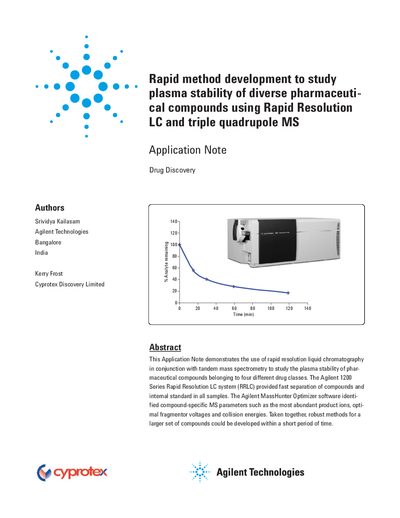
This document details a method for studying the plasma stability of pharmaceutical compounds using rapid resolution liquid chromatography (RRLC) coupled with tandem mass spectrometry. The study analyzed ten compounds from four different drug classes to demonstrate the efficiency of the Agilent 1200 Series Rapid Resolution LC system and the Agilent 6460 Triple Quadrupole Mass Spectrometer.
| Run time | 1.5 min |
|---|---|
| Flow rate | 0.5 mL/min |
| Column temperature | 50 °C |
| Drying gas temperature | 350 °C |
| Capillary voltage | 2000 V |
| Sheath gas temperature | 400 °C |
The Agilent MassHunter Workstation (version B.02.00) was used for data acquisition, and MassHunter Quantitative analysis software (version B.01.04) was used for data analysis.
A compound is considered stable in plasma if the percentages of parent remaining at each time point are within +15% of the 0-min sample.